Reports: November tractor orders disappoint
Orders for North American Class 8 tractors fell more than expected in November, according to new data from FTR Intel and ACT Research.
FTR reported a 17% month-over-month dip to 20,200 units, which is down 44% year-over-year—and well below the 10-year November average of 28,910 trucks. Orders have totaled 214,797 units over the last 12 months, FTR added.
The pullback persisted despite modest improvements in tariff and regulatory clarity. Fleets continued to defer replacement and expansion plans amid weak freight demand, persistent excess capacity, elevated financing and equipment costs, tariff volatility, uneven economic conditions, evolving emissions requirements, and sustained margin pressure. Both vocational and on-highway segments posted m/m and y/y declines. Vocational outperformed on-highway on a y/y basis, reflecting continued, but cautious, demand heading into 2026.
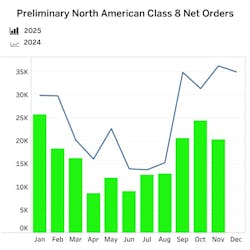
Concerns are rising for the 2026 order cycle, FTR contined. Cumulative net orders from September through November were down a striking 36% y/y. However, the market has more clarity now than it did a couple of months ago regarding tariffs on heavy-duty trucks and likely changes in the Environmental Protection Agency’s 2027 NOx rule. Overall, the tariff structure raises costs but in a measured, targeted manner, supporting reshoring while avoiding significant short-term disruption to Class 8 sourcing and production. The expected elimination of the extended warranty requirements in the NOx rule likely will reduce costs substantially, perhaps by around half of the expected increase previously, according to some estimates.
“So far, improved clarity has not been enough to offset a host of challenges—weak freight fundamentals, limited carrier profitability, elevated capital costs, and so on—that continue to keep fleets on the sidelines,” Dan Moyer, FTR senior analyst for commercial vehicles, said in a news release. “Fleets are emphasizing cost control, maintenance discipline, and asset utilization over growth, delaying any meaningful rebound in equipment demand until economic and market conditions firm.
“For truck manufacturers and suppliers, forward visibility remains limited, and order activity is likely to remain uneven until freight volumes and rates show a sustained recovery.”
Weak profitability creates bottleneck
ACT pegged the November Class 8 order count at 19,700 units, which is down 47% year-over-year in what typically is the year’s third-strongest month.
Class 5-8 orders totaled 36,000 units in November, ACT added.
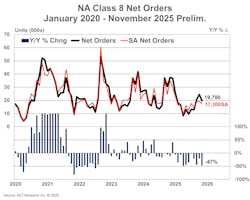
“Despite last month’s announcement regarding EPA ’27 adding much-needed clarity for the market, the obvious bottleneck to stronger order activity is lack of carrier profitability,” said Carter Vieth, ACT research analyst. “Spot rates continue to tread along the bottom, and while supply is coming out of the market, demand in key freight sectors is lagging.”
Regarding medium duty, Vieth said, “Preliminary reporting shows November NA Classes 5-7 orders decreased 2.9% y/y to 16,300 units. Medium duty continues to be impacted by small businesses getting crushed by tariffs, uncertainty, and levels of consumer pessimism typically reserved for recessions.”